The Overseas Hiring Mistake That Has Nothing to Do With the Person You Hired
When an overseas hire doesn't work out, most business owners land on the same explanation: wrong person, wrong agency, wrong country. Sometimes that's true. More often, the placement was set up to struggle before anyone started, because of what got handed over and how. The mistake isn't who you hired. It's what you gave them to do.
You delegated a job title, not a job
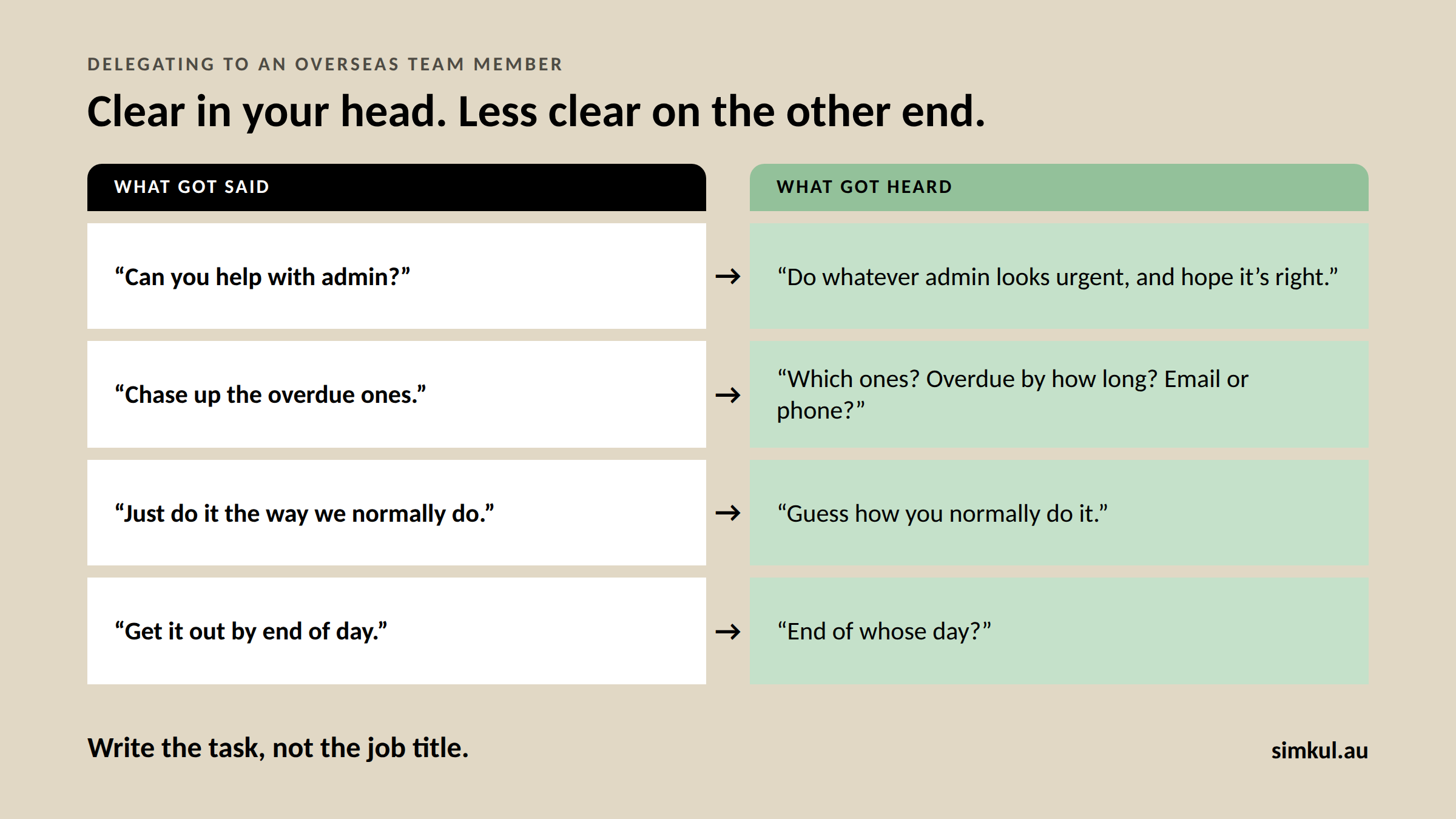
"I need someone to help with admin" isn't a role, it's a feeling. Without the real list of tasks, the person you hire has to guess what "helping with admin" means on any given day, and guess wrong often enough that you start doubting the hire instead of the brief. Write down the actual tasks before you post the role: which invoices, which system, which client emails, in what order, by when. If you can't write that list yourself yet, that's worth knowing before you hire, not after.
You kept the context in your own head
A local hire can absorb context by osmosis: overhearing conversations, noticing what's urgent, asking a colleague at the next desk. Someone working remotely from another country doesn't get any of that unless you build it in on purpose. If the "why" behind a task only lives in your head, it never makes it to them, and they'll do the task correctly by the letter and wrong in spirit. A five-minute voice note explaining why a step matters, recorded once, will save months of quietly wrong work.
You measured the wrong thing
Some owners judge a remote hire by hours online rather than work delivered, because presence is easier to see than output. That pushes good people toward looking busy instead of getting things done, and tells you nothing about whether the work is right. Judge the outcome instead. Did the invoices go out correctly? Did the queue clear? Did the client actually get a reply that solved their problem? That's the number that matters, not a green dot next to someone's name.
You never checked whether the scope still fits
The task list you wrote in week one is rarely the task list that still makes sense by month six. Businesses grow, priorities shift, and a role that was well-scoped at the start can quietly turn into three unrelated jobs stitched together. Revisit the role properly every quarter: what's been added, what's stopped mattering, what's now taking twice as long as it should. If it's drifted, that's not the hire's fault. It's a scope problem, and it's fixable.
None of this means overseas hiring carries more risk than hiring locally. It means the same rule applies either way: a role that isn't clearly scoped will struggle, no matter who fills it, wherever they're sitting. Before you write off the next hire as the wrong fit, look honestly at what they were handed on day one, and how much of the job only ever lived in your head. If this resonates, we'd love to have a conversation. Find us at simkul.au.