Business Conditions Turned Negative. Here's What That Means for Your Business
NAB's latest quarterly survey has business conditions below zero for the first time since September 2020. Sales margins are at their lowest point since June 2020. If you've felt costs climbing faster than you can lift your prices, the numbers back you up. That's not a reason to panic. It's a reason to look hard at where your money is going, before you reach for the blunt instrument of cutting people or cutting corners.
What changed
Business conditions fell three points to minus two in the September quarter, according to NAB's Q3 2026 Quarterly Business Survey. Sales margins dropped four points to minus twenty. Confidence was the one bright spot: it rose eight points, though at minus eleven it's still well below its long-run average. Put simply, owners feel a little less gloomy about what's ahead while the day-to-day numbers get harder.
Why margins are getting squeezed
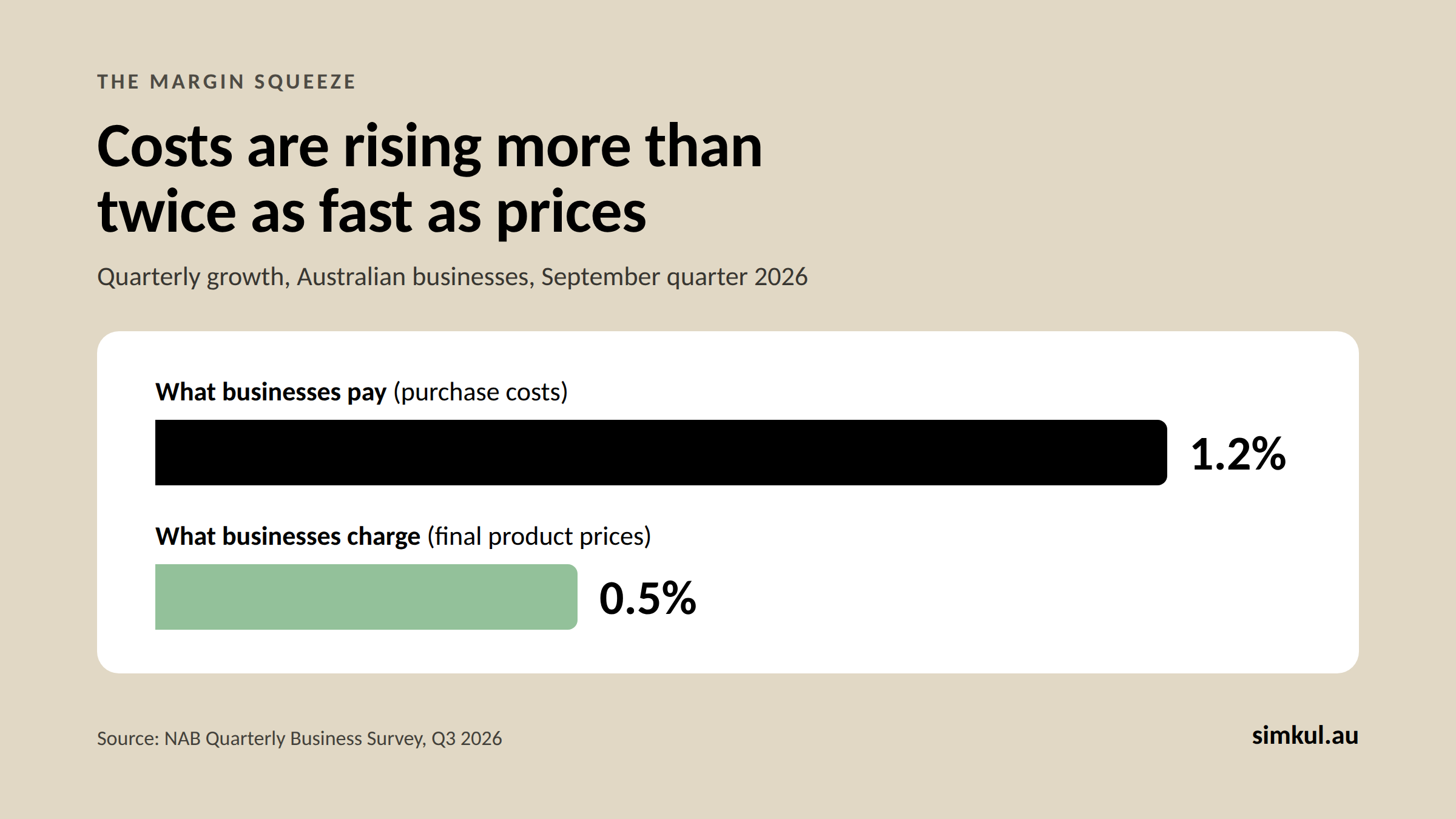
Purchase costs rose 1.2% over the quarter. The prices businesses charged for what they sell rose 0.5%. So costs are growing at more than double the rate owners feel they can pass on. If your supplier invoices have crept up while your quotes have barely moved since last year, this is the same story with your name on it.
Labour is the biggest pressure
When NAB asked what's weighing on confidence, labour costs came out on top, with margins close behind. Finding people is still hard too: 29% of businesses said labour availability was a significant constraint on how much they could produce. That's an awkward mix. Staff cost more, the right ones are hard to find, and there's less margin left to absorb either problem.
Where to look first
When margin is the problem, the instinct is to cut the biggest line item, which is usually people. That's often the wrong move when nearly a third of businesses already can't find enough of them. The better first move is finding where money and time leak out of the business that nobody's looked at properly: the admin still done by hand, the process that needs three people because nobody wrote down how to do it with two, the local role carrying work that doesn't need someone in an Australian office to do it well. None of that shows up in a NAB survey. It's usually where the real recovery in margin sits, and it's a steadier fix than waiting for the next quarter to turn.
A negative conditions reading doesn't mean your business is in trouble. It means the cost side of the ledger needs the same attention the revenue side usually gets. If margin is the number that's actually moved for you this year, the fix is rarely a bigger sale. It's usually a leaner way of doing the same work. Not sure what this means for your business? We can help you work through it. Visit simkul.au.
Sources: